

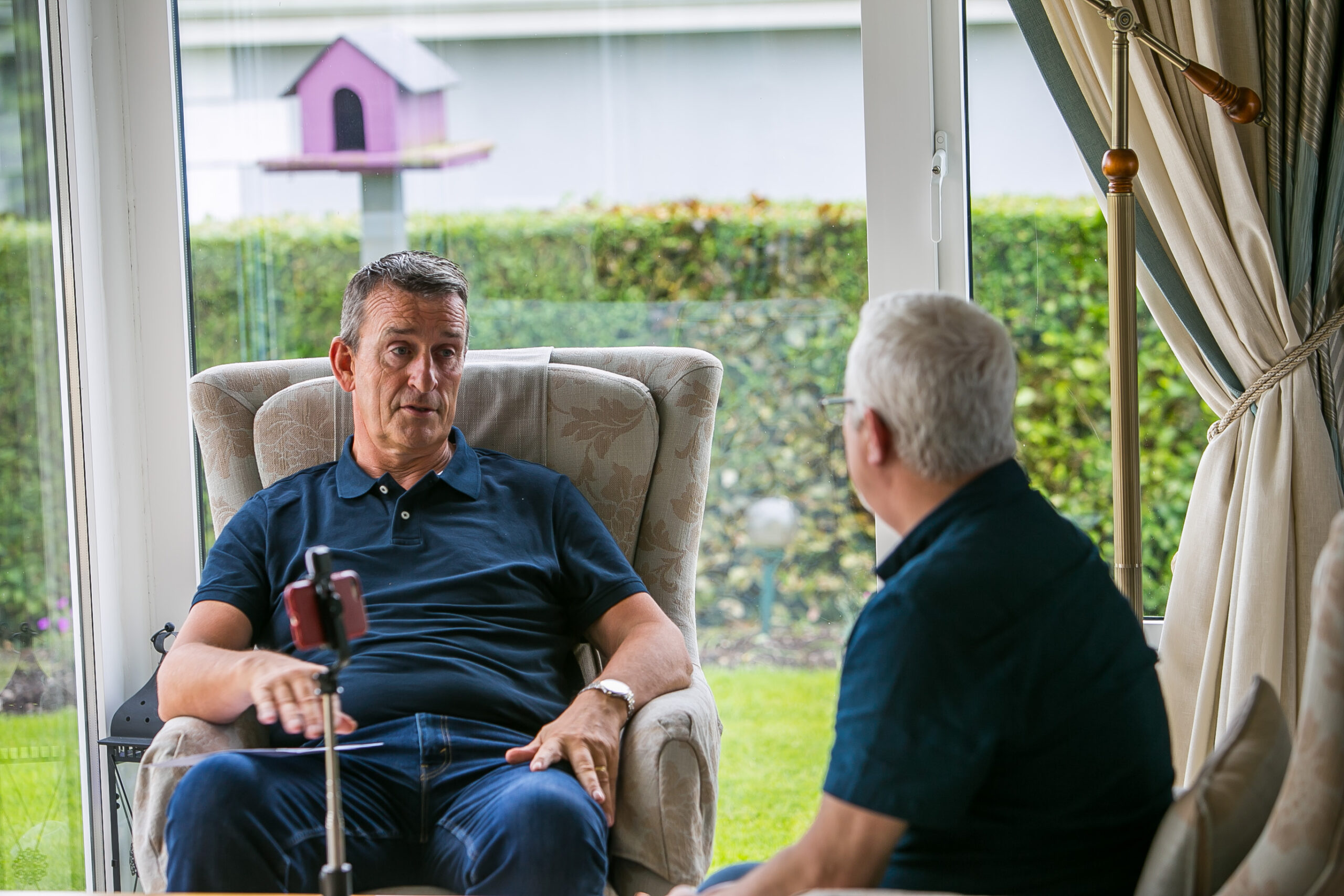
Brendan is a fan of Keith Earls, Michael D, Mary Robinson and fly-fishing. Here’s a taste of how his conversation with editor Allen Meagher went:
AM: What’s the last book you read?
BOL: I just finished Keith Earls’ autobiography. It won sports book of the year. Keith was an amazing Irish rugby player and he’s a really interesting character. He has struggled with his mental health and to achieve what he’s achieved with all of the disadvantage is impressive, but also his recognition of his disadvantage is phenomenal.
AM: How and why did you get involved? Why didn’t you become a plumber or a politician?
BOL: I sometimes thought I should have become a carpenter, because every day you’d be able to see progress. I grew up in Ballinrobe in Co Mayo and I was a student of the 70s and did my Leaving Cert in the early 80s. At that time six or seven of the 20 lads that I did my Leaving Cert with in the Christian Brothers school – their fathers worked in England. As you went further west in Mayo the number of emigrated fathers went above 50 per cent. It was a huge time of emigration and there were amazing things happening in communities at that time.
AM: Outside of family, name three people you most admire?
BOL: I did sociology in UCG and Michael D was one of my lecturers and he had a strong social conscience. As President he gets around to a lot of projects that relate to disadvantage and he can relate to them.
Mary Robinson is another hero of mine. She became the ultimate stateswoman. Her work on climate change and how it impacts the most disadvantaged is really fascinating for me and she sticks at it.
I worked in Tanzania and Julius Nyerere, known by the Swahili name Mwalimu, or ‘teacher’, because of his profession, was the president. He was a natural leader. It was a socialist country where everybody had responsibility and a role within that, very much based on equality, and he was somebody that that certainly inspired me. I had the privilege of meeting him once.
AM: How did you end up in Tanzania?
BOL: I met Bernie when I was doing my Leaving Cert. We married young and went to Tanzania 10 days later and stayed for 27 months, so we had the longest honeymoon in history. We went there to support small co-operative development.
People often ask me what was the difference between working in Africa and working in Ireland and I say only the weather and the colour of the skin; everything else was the same.
YESTERDAY’S ISSUES V TODAY
AM: Name three top social inclusion issues facing communities in Ireland today?
BOL: Drugs. Migration. And polarised societies.

AM: Are there any issues that have persisted since you began work to this day?
BOL: The underfunding and under-resourcing of supports to the most disadvantaged continues to be a challenge.
AM: Name any social inclusion issue that was big in the past and is far less of a concern today.
BOL: Unemployment.
AM: Briefly, what does Ireland need more and less of?
BOL: We need more resourcing for community work. Local authorities are under-resourced as well.
Nationally, we need less spin. We need less social media. We need more leadership in local communities and that needs to be supported. We’re in a very dangerous place where you’re either one thing or another. There is less space by a long shot for people with common sense.
That role that communities had in planning strategies, where they had authority in their area, where a group of people with common sense took a balanced approach – it is diminishing. Now social media has taken over. It’s a problem – something can kick off very quickly now.
AM: People in communities created something wonderful out of nearly nothing in the 1980s/90s. What was the vibe like back then?
BOL: People had a hardness and toughness. Amazing things were done in communities back then: You had the growth of the co-operative movement and producer groups and farm organisations. That’s where I first encountered the likes of Michael D and Chris Curtin and people like that who were very involved in community activity right across the western region and I was taken with that.
When I came to work in Banagher in 1990 a big factory had just closed down. Shannon Development and FAS had supported a role for exploring what the community could do about this. They bought a building in the town and turned it into a visitor centre and there are 30 or 40 people working in that building now. They raised money when there was no money. They persisted with projects. It was like that right across the country
The vibe was committed and determined and there was nothing going to stop them. I was seeing volunteers out fundraising at every hand’s turn. We hadn’t got into CSR or professional fundraising. This was local people going door-to-door and collecting phenomenal amounts of money.
AM: How long were you involved with OLDC and in development work more generally?
BOL: I worked with OLDC for 15 years and before that with West Offaly Partnership for 15 years. Before that, I worked for four years with a co-op in Banagher. I believe in social enterprise, it doesn’t necessarily have to be a co-operative. There are now other options.
AM: What is it about sharing the burden that gives a different type of satisfaction?
BOL: Communities create a vision, come up with a project and how they’re going to do it and then strive to achieve it. In OLDC we were always careful to ensure that communities that achieved what they set out to do celebrated that. Reflection and celebration is something all organisations should do. Community organisations and volunteers and people who work in the local development sector are often very hard on themselves.
AM: Would you have any motto or words of advice for somebody starting off today in development work?
BOL: Stick with it!
To watch Changing Ireland’s interview with Brendan O’Loughlin in full, click here.


