
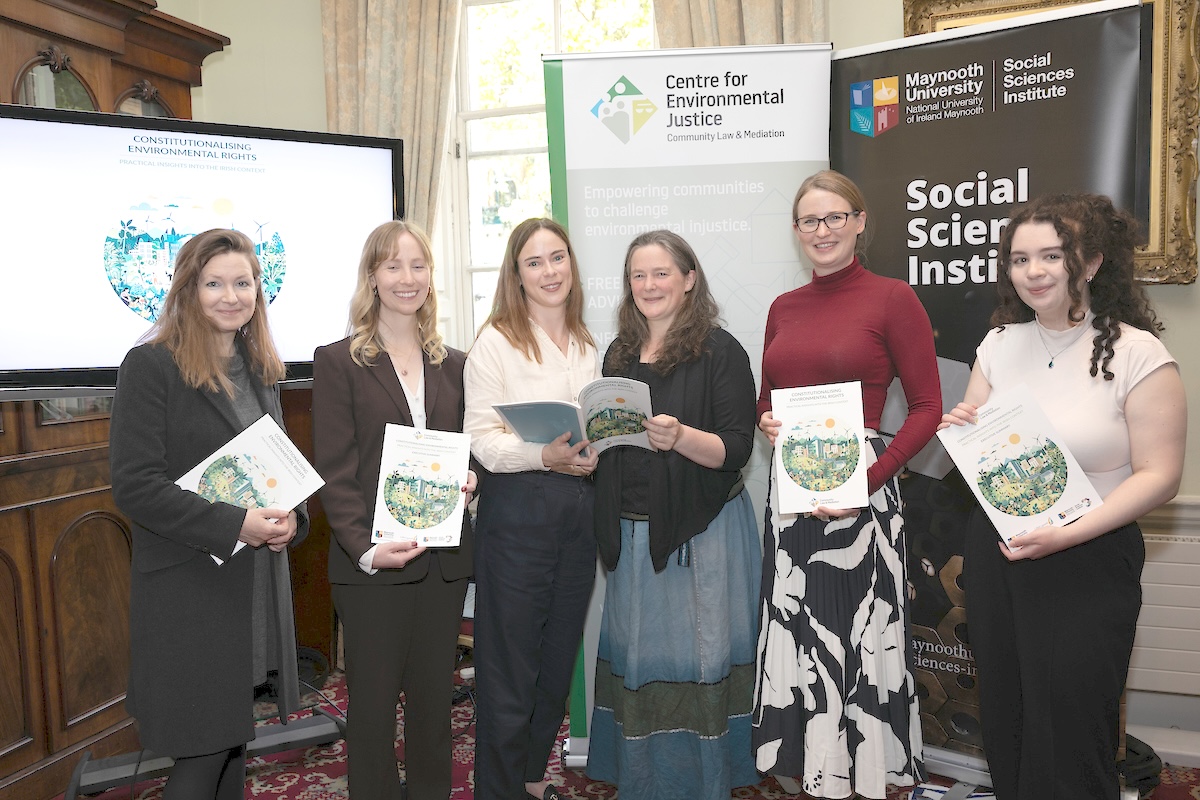
“There is no charge for people availing of our services, but the services are primarily targeted at those impacted by disadvantage and inequality,” said Elizabeth Devine policy and communications manager.
Clodagh Daly is the centre’s manager and she outlined why there was a need for the environmental justice service.
“We (had) people coming to our clinics whose health was being impacted by air pollution for example. We (had) people come in whose homes were repeatedly flooded and they could no longer get insurance. We realised that there was a gap in meeting that legal need and that’s why we set up the centre,” she said.
Environmental issues are becoming much more prevalent and the CEJ now employs four staff to give communities support.
“There are so many issues that people are presenting to the clinic with. So many people can’t afford their energy bills and about a third of the country’s population struggle to pay their heat and electricity bills. People are struggling with lack of access to green space, children who don’t have parks or playgrounds nearby. Poor housing conditions, water quality in urban as well as rural areas. (Some) people are dealing with severe water pollution. There are all those kinds of issues,” said Clodagh.
The CEJ is currently at work on two major cases relating to climate justice.
One is challenging the Climate Action Plan 2023, that’s a core plank of the Irish Government’s climate policy. The case was due to be heard at the Court of Appeal this summer. At stake is the argument that the Government has not published a sufficiently detailed Climate Action Plan. For instance, it is not clear from the plan how emissions will actually fall in line with our legally binding carbon budgets.
“The reason that we are involved in that case is that the longer that reductions in emissions are delayed, reductions consistent with the legally binding carbon budgets that the Government have agreed to, the more difficult they will become. The policy response might become abrupt, forceful and disorderly, and we won’t be able to have that just transition and the consultation required with communities,” said Clodagh
The CEJ is involved in the case representing Friends of the Irish Environment as their client.
“The other case that we’re taking is against the Climate Action Plan 2024, in which some of the same issues persist. So we decided to challenge that as well,” she said.
“We’re challenging it because it doesn’t detail how emissions will fall in line with Ireland’s carbon budgets. We’re also claiming that as a result there is an infringement of fundamental rights under the Irish Constitution, the European Convention on Human Rights and the EU Charter of fundamental rights. In that case we are acting as the client for the first time in our history and we are joined in that by a grandfather, a youth climate activist and a child, represented by their mother. It’s a really exciting case.”
Anyone is welcome to consult with the CEJ to see if their issue comes within its remit.
The centre has offices in Coolock and Limerick, but is open to enquiries countrywide.
“Anyone can avail of our clinics,” said Clodagh. “We offer clinics in person every fortnight or you can access them by phone or by Zoom, whatever is suitable for people. There’s no query too big or small. Basically, a clinic is a meeting with a solicitor which will usually last for 20 too 40 minutes and people can book a follow up consultation if needed.”
She feels the centre will become even busier in the near future.
“I think there is a real need for it,” said Clodagh.
More info: https://communitylawandmediation.ie/centre-for-environmental-justice/
What is Environmental Justice? Give me examples!
Environmental justice seeks to protect people from the impacts of climate change and other environmental harms. It seeks to ensure the fair treatment and meaningful involvement of all people in the development, implementation and enforcement of environmental laws, regulations and policies.
Communities who experience disadvantage or marginalisation are often more vulnerable to climate injustice.
Environmental harms can include:
• Health concerns from air or water pollution.
• Illegal dumping/ littering.
• The burning of private waste.
• Homes at risk of flooding.
• Flooding or lack of flooding infrastructure in high-risk areas.
• Poor housing conditions (cold, damp).
• Poor sanitation or poor access to clean water.
• Lack of access to green space, parks etc.
• Noise pollution.
• Energy costs and access to retrofitting schemes or fuel allowance.
• Pollution of lakes, rivers and marine life.
• Inadequate traffic/ cycling infrastructure.
• Dereliction.
• Biodiversity loss.
• Mining, coal extraction and fracking gas.
• Difficulty accessing information on environmental issues.


