

– Uíbh Ráthaigh avails of Creative Places funding in quest for solutions
– By Allen Meagher in collaboration with Breandán Ó Caioimh
A play called ‘Taigh Tŷ Teach’ was staged in An Dromaid Community Centre on the Iveragh peninsula in February, 2024, and it illustrated the challenges facing communities in the three Celtic countries.
The tri-lingual play saw nine actors speaking Irish, Scots Gaelic and Welsh as they dramatised the challenges with regard to holiday homes, AirBnB lets, a lack of supply, unaffordability, youth out-migration and the associated decline in, and threats to, indigenous culture and identity – especially the Celtic languages.
Breandán reports that the play coincided with the launch of a community-led housing pilot project called Togra Tithíochta Uíbh Ráthaigh – which envisages a four-pronged approach to improving the housing situation locally, based on:
– new-build and affordable rental homes;
– renovation of vacant properties for affordable purchase;
– community-led approaches (including a community land trust);
– and embedding housing within a wider community development and family support framework.

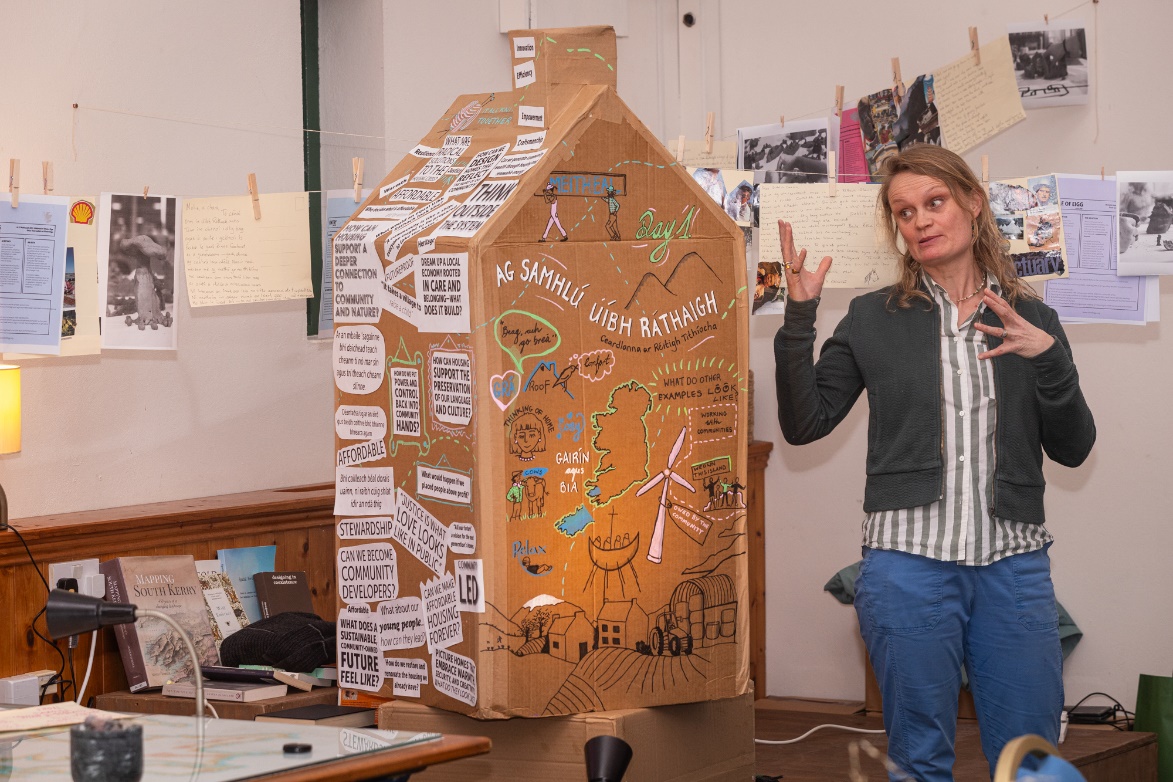
This also comes at the same time as people are considering the results of an artist residency project called Tochail (meaning to excavate) which sought a fresh approach to the housing issue in South Kerry and beyond.
Tochail came about through the Arts Council’s Creative Places (Cumas Ceantar) programme, which has so far invested in 19 places that have had fewer opportunities than other areas to take part in the arts. (A recent round for new funding applications closed in March).
The Creative Places approach is underpinned by inclusion and diversity and is grounded in socially engaged arts practices and community development principles.
Local stakeholders partnered nationally with TASC, an independent think-tank whose mission is to address inequality and sustain democracy by translating analysis into action.
In Iveragh, the project was coordinated by Comhchoiste Ghaeltacht Uíbh Ráthaigh (the community development organisation for the South Kerry Gaeltacht) and it was delivered through a steering group involving local community representatives, agencies, including Tascfhórsa Uíbh Ráthaigh (under the aegis of Údarás na Gaeltachta), Ealaín na Gaeltachta and Kerry County Council (which provided funding of €10,000 to support the project).
As a result, local people have depicted their hopes and visions in workshops, storytelling and other art forms.
Participants emphasised community-building and the Irish concept of ‘Meitheal’ (mutual support) in their vision for future housing. They noted that housing, climate resilience, community development, and language revitalisation are interconnected.
Breandán says that, “Arts-based approaches can reframe housing debates, making them more inclusive, imaginative, and solution-focused.”
The Tochail project also offers a replicable model for other rural communities facing similar challenges, something which should be of interest to councillors and officials who are interested in housing and/or the arts.
“It is also relevant to those interested in policy-making and the interfaces between the policy domains of local government and the communities they serve,” says Breandán.


