

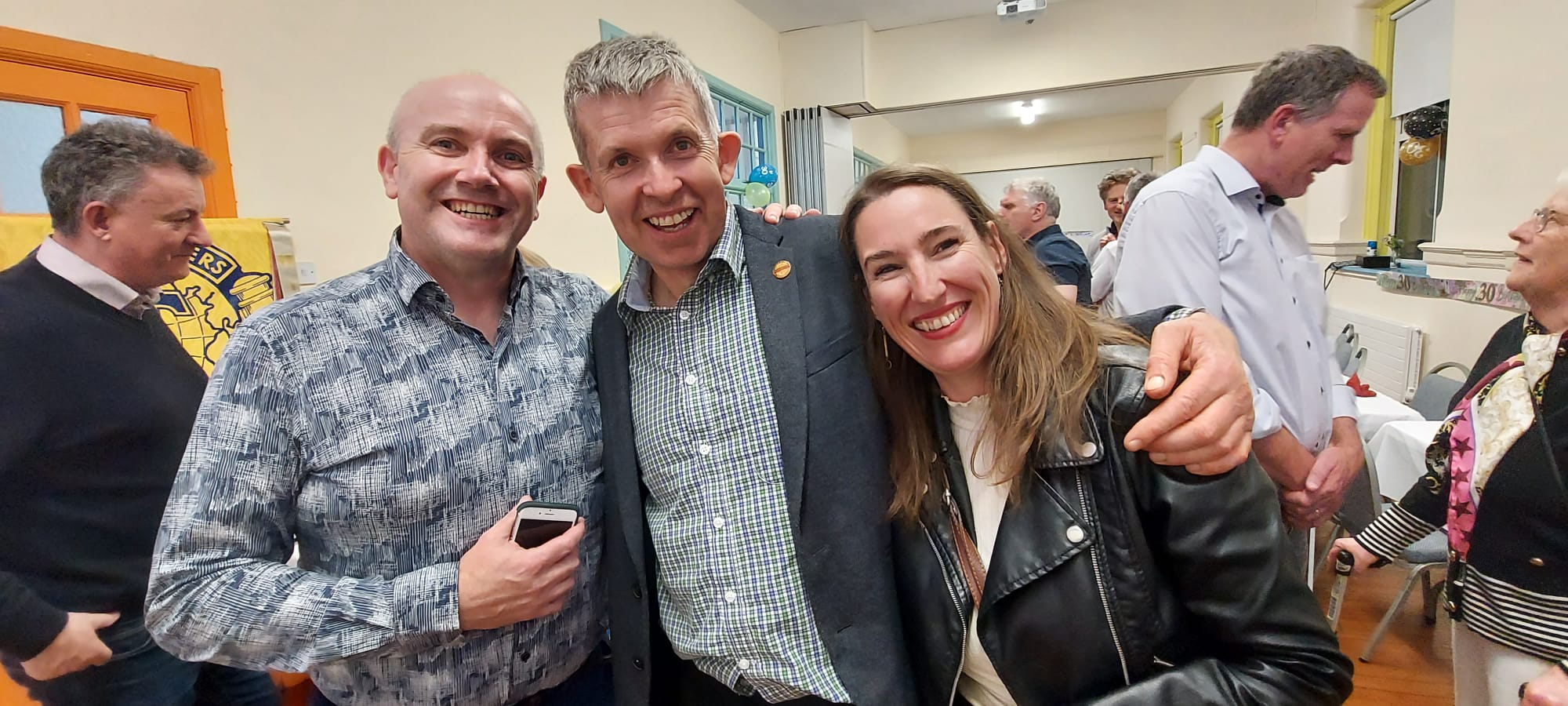
PHOTO: Our lead image shows – Charles Malone (centre) with fellow members celebrating 30 years of Tullamore Toastmasters.
Delivering calves during online meetings
For some time Tullamore Toastmasters had gone with hybrid meetings, but they felt they were left with no option but to cut those out.
“There wasn’t a connection with the people online. There were two different meetings; people online was one meeting and those in the room was another. When you were doing a speech you didn’t know where to look; at the people in the room or at the camera,” says spokesman Charles Malone.
People were drifting away from the club and they felt cutting the online dimension was the only way it could endure.
“It was a hard decision. We have members in America, but numbers were declining and we felt the only way for the club to survive was to go back to in-person. So far it looks like we’ll have four new members, even though we are losing three.”
Charles personally benefited from the hybrid options, but he realises the change is required: “Hybrid meetings were very handy for me because I’m a farmer. If I had a cow that was going to calve I could stay at home and still go to the meeting,” he says.

Cards, bingo and social dancing were slow to return
The Tullamore experience raises an interesting question more than three years after the Covid restrictions were lifted and the end of a bleak period in history arrived: What was the lasting impact of the pandemic on community groups?
Anne Cassidy of Galway Rural Development says that she feels social groups were a bit slower to return than committee based organisations.
“Community activities, where there might have been bingo on, or cards, or set dancing, those kind of things seemed to take a long time to come back, if they came back at all. This is anecdotal, but that’s what I would say struggled to come back, compared to the Men’s Shed or the ICA or the Tidy Towns, those groups that come together to do stuff.
“Yes, those did take time to get going again, but I didn’t really hear of many losses. More things like people organising community activities like cards or bingo or social dancing; those seemed to be more likely not to come back or to be very slow about coming back.”

Anne understands why certain things didn’t return, as people re-evaluated things.
“If two or three people were responsible for organising, maybe they asked themselves ‘do I really want to go back?’ Also they may have been older, or the momentum was gone. Those were the things I would say struggled more in my experience. The groups seem to have survived.”
However, she feels there have been a number of new groups have sprung up in rural Galway: “Now, there are a lot of new groups forming, and coming to us looking for support. There is no shortage of groups in most areas, I would say, there is a lot of stuff going on.”
“Fierce” demand for hobby classes shows desire to connect

Fergal Conlon of the West Cork Development Partnership feels that different types of groups changed in different ways and he feels volunteerism took a hit for a while.
“I didn’t notice it too much in social groups, things like Active Retirement. I noticed it in delivery groups; things like community associations, your sports club, your committees, the ones that would be running stuff as opposed to socialising. They were struggling to get volunteers to get involved.”
He feels that people broke long standing habits and didn’t return to them very easily.
“For me, it wasn’t a fear of Covid, it was just that people had got out of the habit, as simple as that. I suppose people got used to different things. Your average committee person would be attending a meeting two or three times a week for different committees they’d be on, and it was a way of life for people. A very rural way of life in particular, you’d have so many great community stalwarts, and that habit was lost.”
However, he says that a tendency towards community involvement did come back slowly, and now things are somewhat like they were: “In terms of the community development piece, I haven’t heard any reflection on Covid for a while, which is a good sign.”
He says there are many people looking to do part time courses now, and that this reflects a wish for connection.
“These hobby classes, such as learning gardening or photography, whatever it might be; there’s a huge demand for them. There’s a fierce amount of people doing those. And that’s a sign of people getting out and about and socialising, and there’s an appetite for it.”
He has also noticed that communities are coming together to respond to crises in a new way.
“After Storm Eowyn there is this idea of community readiness, to address emergencies. You see soup kitchens, charging banks, places like that particularly when there is no electricity. Covid is related to it, Storm Eowyn, even Ukraine, there is this idea of community readiness and responding to things,” said Fergal.


